

Are Orthopedic Dog Beds Worth the Price?
Table of Contents
- The Real Cost of Orthopedic Dog Beds vs. Regular Options
- Orthopedic vs. Regular Dog Bed: What Actually Matters
- Best Orthopedic Dog Bed for Dogs with Arthritis
- How to Choose an Orthopedic Dog Bed That Lasts
- Orthopedic Dog Bed Durability: What You'll Get for Your Money
- Long-Term Savings: Medical Costs vs. Bed Investment
- Conclusion
- Frequently Asked Questions
Last Updated: October 6, 2026
The Real Cost of Orthopedic Dog Beds vs. Regular Options
An orthopedic dog bed costs two to three times more than a standard bed. So are orthopedic dog beds worth the price when it comes to your dog's comfort and health?

Orthopedic beds address a problem regular beds don't: they distribute weight evenly, reduce pressure on joints, and support senior dogs, dogs with arthritis, or those recovering from surgery.
Durability matters too: buying five cheap beds over a decade costs more than one quality orthopedic option, and once you factor in reduced vet visits and joint medication, the financial case gets stronger.
Orthopedic vs. Regular Dog Bed: What Actually Matters
The core difference is support structure and material density. An orthopedic bed uses high-density foam, typically memory foam or egg crate, that conforms to your dog's body and holds its shape for years.
Memory foam excels at pressure relief: it responds to body heat and weight, creating a customized surface that reduces strain on pressure points, critical for dogs with arthritis or hip dysplasia.
Cover material also separates these options. Quality orthopedic beds have removable, washable covers, often with waterproof liners, essential for incontinence or post-surgery recovery.
Non-slip bottoms matter more than they sound.
| Feature | Orthopedic Bed | Regular Bed |
|---|---|---|
| Foam Density | High-density memory or egg crate | Basic cushioning |
| Pressure Relief | Excellent (conforms to body) | Minimal |
| Durability | 3-5+ years | 1-2 years |
| Washable Cover | Yes, removable | Often fixed |
| Waterproof Liner | Typically included | Rarely included |
| Non-slip Bottom | Usually included | Not standard |
| Best For | Senior dogs, arthritis, recovery | Young, healthy dogs |
Best Orthopedic Dog Bed for Dogs with Arthritis
Dogs with arthritis need beds that reduce joint stress and provide consistent support. The best choice combines memory foam thickness, cushioning matched to their weight, and warmth, which helps arthritic joints.

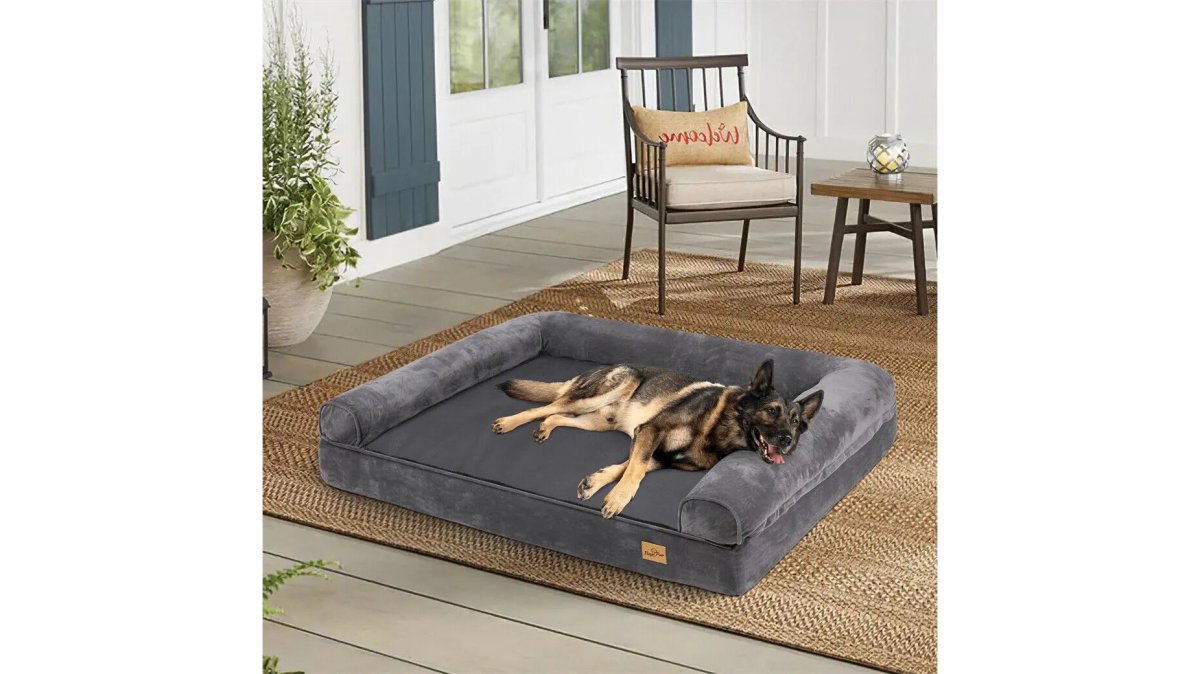
Our top recommendation for most dogs with arthritis is the Dog Bed Extra Large Orthopedic Pet Mattress at $137.99, with thicker sponge foam that doesn't sink, three bolster edges for arthritic joints, and a waterproof liner.
For dogs under 25 pounds, the JHK Orthopedic Dog Bed Memory Foam Pet Bed at $43.99 delivers orthopedic support without the premium price: high-density foam for joint support and a removable cover that simplifies cleaning.
Bolster edges serve a practical purpose for arthritic dogs: they give something to push against when getting up or shifting position, reducing strain on hips and knees.
How to Choose an Orthopedic Dog Bed That Lasts
Choosing the right orthopedic bed means matching three factors: your dog's weight, health needs, and the bed's durability features.
Start with size. The M-3XL Rectangular Dog Beds Orthopedic Dog Pet Sofa Couch Bed at $49.99 lists clear weight capacity per size, from 35 pounds for the medium to 132 pounds for the extra large.
Next, assess foam thickness.
Check cover material and washability. The Dog Beds for Large Dogs, Orthopedic Dog Bed for Medium Large Dogs at $53.99 has a machine-washable cover.

Verify the non-slip bottom: a bed that slides defeats the purpose for dogs with mobility issues, and 600D oxford cloth backing keeps it in place.
Orthopedic Dog Bed Durability: What You'll Get for Your Money
The math shifts in favor of orthopedic beds, but only if you treat the bed like equipment rather than a pillow. The useful question: what degrades, how do you slow it down, and when do you replace the insert instead of the whole bed?
What actually fails first
Four components fail on different timelines:
- The foam core, the expensive part. Memory foam and high-density polyurethane foam lose height and rebound as they compress under repeated load. A dog that sleeps 14+ hours a day on the same spot creates a permanent body-shaped depression long before the cover wears out.
- The waterproof liner, the cheapest part and the one that protects the expensive part. Once the liner cracks or the coating delaminates, moisture reaches the foam and the clock accelerates.
- The zipper and seams, usually the first visible failure. A #5 nylon zipper on a 100-pound dog's bed is a wear item.
- The cover fabric, pilling, matting, and bolster seam splits from repeated entry and exit.
Foam density and ILD: the numbers that predict lifespan
Two specs determine whether a bed survives two years or five:
- Density (measured in pounds per cubic foot, or PCF). Higher density means more foam material per unit volume, which resists compression set. Beds in the 1.5-2.5 PCF range are typical for budget orthopedic beds; 3 PCF and up is where you start seeing multi-year shape retention.
- ILD (Indentation Load Deflection), how firm the foam feels under load. This is the spec that prevents "bottoming out." A dog that weighs 80 pounds needs a higher ILD than a 15-pound dog, or the foam compresses to the floor and the orthopedic benefit disappears.
A practical rule: match the foam's rated support to the dog's weight, not the bed's marketing label. A "large" bed with 2 PCF foam and low ILD bottoms out under a 90-pound Labrador within months; the same size with 3 PCF foam holds its shape for years.
Dog Beds for Large Dogs, Orthopedic Dog Bed for Medium Large Dogs Waterproof →
Maintenance protocol that extends foam life
- Wash the cover every 2-4 weeks (more often for incontinent or post-surgical dogs). Use cold water and air-dry, heat breaks down the waterproof coating on the liner.
- Never machine-wash or machine-dry the foam insert. Waterlogged foam grows mold; heat destroys cell structure. Spot-clean with a damp cloth and let it air out fully.
- Rotate the insert 180 degrees every 2-3 months. This spreads compression across the surface and roughly doubles the time before a permanent depression forms.
When to replace the insert vs. the whole bed
- Replace the insert when the foam no longer springs back within about 10 seconds of your dog standing up, or when you can feel the floor through the bed with moderate hand pressure.
- Replace the cover when the zipper fails or bolster seams split, covers are usually sold separately and cost far less than a new bed.
- Replace the whole bed when the foam has compressed to less than about 70% of its original height in the dog's sleeping zone.
The certification angle most articles miss
Foam quality isn't just density. Look for CertiPUR-US certification, which verifies the foam was made without ozone depleters, certain flame retardants, heavy metals, and formaldehyde, and that VOC emissions meet indoor air standards, important for a bed your dog breathes against 14 hours a day.
The waterproof liner is the durability secret: it protects the foam from accidents, moisture, and spills.
According to veterinary guidance on pet comfort and joint health, proper bedding support reduces joint stress and can delay the progression of arthritis-related mobility issues.
Long-Term Savings: Medical Costs vs. Bed Investment
The financial case becomes compelling only if you run the actual numbers. Let's itemize both sides.
The bed side of the ledger
A quality orthopedic bed runs roughly $44-$138. Spread over a realistic 4-year lifespan with the maintenance routine above, that's about $11-$35 per year. Add a replacement liner every couple of years ($15-$25) and a spare cover ($20-$40), and you're still under $50 per year.
Compare that to buying a $25-$40 regular bed every 12-18 months: over four years that's $75-$130, plus disposal, plus zero joint support. The orthopedic premium is often smaller than the marketing makes it look.
The medical side of the ledger
For a dog with moderate arthritis, typical annual costs break down roughly like this:
- Veterinary visits: $50-$150 per visit, often 2-4 visits per year for pain management, medication adjustments, and monitoring, $100-$600 annually.
- Joint supplements (glucosamine, chondroitin, omega-3s): $20-$60 per month for quality products, $240-$720 annually.
- Prescription pain medication: $30-$100 per month depending on drug and dosage, $360-$1,200 annually.
A realistic mid-range total for a dog with moderate arthritis lands around $1,000-$2,000 per year. A quality orthopedic bed doesn't replace any of that, but it can reduce pain severity and improve mobility, often meaning fewer flare-ups, lower medication doses, and less frequent emergency visits.
The honest caveat
No bed prevents arthritis or substitutes for veterinary care; the savings case is probabilistic, not guaranteed. What the bed reliably does is improve sleep quality and reduce joint pressure during the 12-14 hours a day a senior dog spends lying down, the single largest block of their day.
DIY vs. commercial: the comparison nobody runs
The strongest argument for a commercial orthopedic bed: could you build the equivalent for less?
- Human-grade memory foam mattress topper: a 3-inch queen topper can run $60-$150. Cut it down, and you have a foam core, but no waterproof liner, no removable washable cover, no non-slip base, and no bolster. By the time you add a waterproof encasement ($20-$40), a fitted washable cover ($25-$50), and a non-slip rug pad ($10-$20), you're at or above the price of a purpose-built bed.
- Egg crate foam from a craft store: cheap upfront, but low density and low ILD. It compresses under a medium or large dog within months and offers minimal pressure relief. This is the DIY path that most often fails.
- Where DIY wins: small dogs under 25 pounds, dogs that aren't destructive, and owners who already own a sewing machine and don't mind replacing the foam every year or two.
For most owners of medium-to-large dogs, the commercial bed wins on total cost of ownership, not because the foam is magic, but because the liner, cover, and non-slip base are already engineered to work together and to be replaced individually.
The safety-certification angle
One more cost most articles ignore: indoor air quality. Foam that isn't CertiPUR-US certified can off-gas VOCs, and a dog sleeping nose-down on it 14 hours a day gets the closest possible exposure.
Consider a senior dog with early arthritis: proper orthopedic bedding plus exercise and veterinary care might delay severe symptoms by 1-2 years, saving hundreds in medication and treatment costs while improving quality of life, making the $44-$138 upfront price look small against a $1,000-$2,000 annual medical bill.
Conclusion
Are orthopedic dog beds worth the price? Yes, but only if your dog needs them.
The real value isn't the upfront cost, it's durability, reduced veterinary expenses over time, and genuine improvement in your dog's comfort and mobility.
At Paws N Whiskers Co., we recommend starting with your dog's specific needs. Our M L XL 2XL Dog Bed Jumbo Pet Orthopedic Bed Memory Foam Base at $86.99 combines memory foam support with durability features that deliver years of comfort.
Frequently Asked Questions
Do orthopedic dog beds really work for dogs with joint pain?
Orthopedic dog beds reduce pressure on joints through memory foam and high-density foam that distributes your dog's weight evenly. Dogs with arthritis, hip dysplasia, or post-surgery recovery benefit from improved spine alignment and pain relief during rest. The supportive base prevents sinking and keeps joints properly positioned, which is especially important for senior dogs that spend 12-16 hours sleeping daily.
How much longer do orthopedic dog beds last compared to regular beds?
Quality orthopedic beds with reinforced stitching typically last 3-5 years with proper care, while standard beds often compress and flatten within 1-2 years. Removable, machine-washable covers extend life by preventing permanent staining and odor buildup. The non-slip bottom and waterproof liner protect the foam core, making them a durable long-term investment rather than a disposable purchase.
Are orthopedic dog beds worth it if my dog doesn't have arthritis yet?
Yes, orthopedic beds provide preventive benefits. Even healthy dogs benefit from proper weight distribution and joint support during sleep. Senior dogs and large breeds are prone to joint problems as they age, so starting with an orthopedic bed early can prevent mobility issues. Think of it as investing in your dog's quality of life and potentially avoiding costly veterinary treatments down the road.
What's the difference between memory foam and sponge foam in orthopedic dog beds?
Memory foam conforms to your dog's body shape, providing personalized pressure relief ideal for dogs with existing arthritis or joint pain. Sponge foam offers firm, consistent support that distributes weight evenly and resists compression over time. Both are effective; memory foam excels at pain relief, while high-density sponge foam offers superior durability and maintains firmness longer, making it better for active or heavier dogs.