

Durable Chew Toys for Aggressive Dogs: 2026 Guide
Table of Contents
- What Defines an Aggressive Chewer?
- Safe Materials for Aggressive Dog Chewers
- How to Choose the Right Size Durable Chew Toys
- How Long Should a Dog Chew Toy Last?
- How to Stop a Dog from Destroying Toys
- Interactive vs. Solo Play: Enrichment for Aggressive Chewers
- The Best Durable Chew Toys for Aggressive Dogs: Our Top Picks
- Conclusion
- Frequently Asked Questions
Last Updated: September 22, 2026
What Defines an Aggressive Chewer?
An aggressive chewer is a dog that chews with enough force and persistence to destroy standard toys within minutes, not days. It is a jaw strength and drive profile, not a behavior problem.
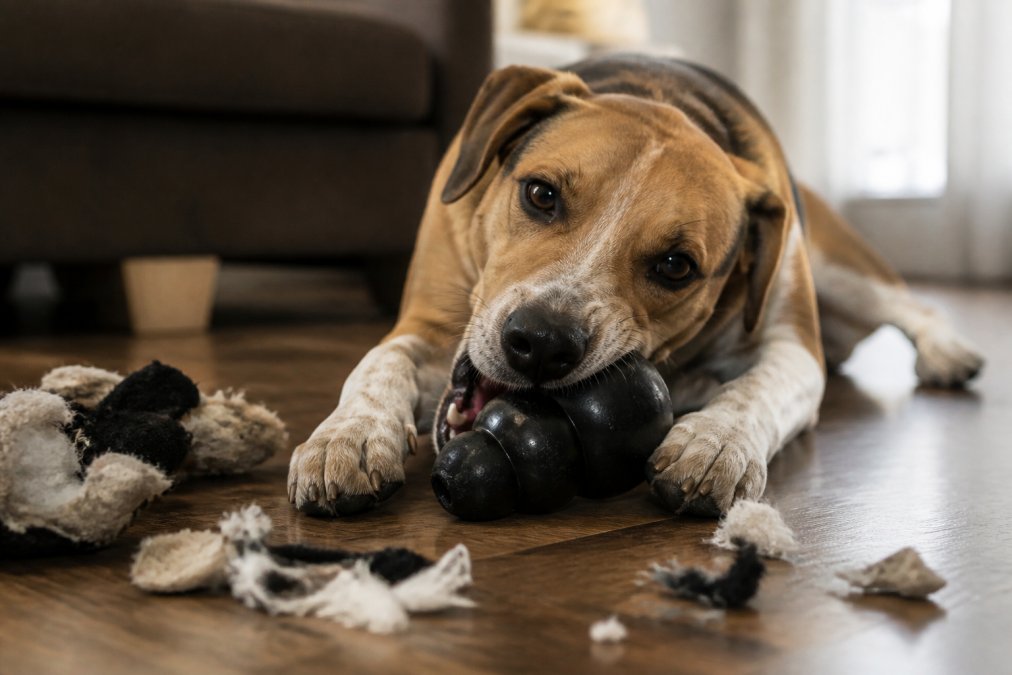
Most owners discover their dog is a powerful chewer the expensive way: a plush toy that lasts a week for a Labrador disappears in under ten minutes with a determined terrier. "Aggressive" describes chewing intensity, not temperament, a dog can be gentle with people and still shred a rope toy in one sitting.
Veterinarians group chewers into three rough tiers: light, moderate, and heavy, with puppy teething in its own category. The heavy tier is where durable chew toys for aggressive dogs earn their name: these dogs apply sustained pressure, work at seams and edges, and keep going after the novelty wears off.
Breed and jaw structure both play a role.
Safe Materials for Aggressive Dog Chewers
Safe materials for aggressive dog chewers share three traits: they resist puncturing, they do not splinter into sharp pieces, and they are formulated without toxic additives that can leach during hours of chewing. Natural rubber and dense nylon are the most common choices, but the material name alone tells you little, two toys can both say "natural rubber" and behave completely differently under jaw pressure.
Here is how the main material types compare:
| Material | Durability | Best For | Watch Out For |
|---|---|---|---|
| Natural rubber | High | Heavy chewers, food-dispensing toys | Can be punctured by determined biters |
| Dense nylon | Very high | Power chewers, solo play | Too hard for puppies or senior dogs |
| Tear-resistant fabric | Medium | Light chewers, interactive play | Not for dogs that shred seams |
| Hard plastic | Low to medium | Short supervised sessions | Can crack and create sharp edges |
| Antler or bone | Very high | Extreme chewers | Enamel fracture risk; not for every dog |
What "Non-Toxic" Actually Means on a Pet Toy Label
Pet toys are not regulated the way children's products are, and no single federal standard governs every chew toy, so the label does a lot of work.
Reading a Label Without a Rulebook
Because there is no mandatory pet-toy safety certification, look for voluntary disclosures. A manufacturer that publishes its material sourcing, names its rubber compound, or states that a toy meets food-contact requirements has done testing it was not legally required to do, usually a better bet than a toy with no material information at all.
Material Choice by Chewing Style
Material safety is also about how a material fails. A safe toy wears down gradually and gives warning signs rather than shattering on the first hard bite. Natural rubber tears and chunks, dense nylon shaves and dulls, and hard plastic cracks. Between two toys at the same price, pick the one whose failure mode is least likely to send you to an emergency clinic.
How to Choose the Right Size Durable Chew Toys
Choose a chew toy slightly larger than your dog can fit entirely inside its mouth. If it disappears past the back teeth, it is too small and becomes a choking hazard; if it is too large to grip, your dog will lose interest and redirect that energy elsewhere.
A simple sizing check:
- The toy should be wider than the space between your dog's back molars
- Your dog should be able to hold it with both paws without the toy touching the floor
- There should be at least an inch of material on either side of the jaw when gripped
How Long Should a Dog Chew Toy Last?
A durable chew toy should last weeks to months for a moderate chewer and days to weeks for a heavy chewer. No toy is truly indestructible, despite packaging claims; lifespan depends on chew intensity, material density, and how often the toy is used.
A rough replacement guide:
| Chewer Type | Expected Toy Lifespan | Replacement Signal |
|---|---|---|
| Light | Several months | Minor surface wear |
| Moderate | Weeks to a few months | Visible cracks or thinning |
| Heavy | Days to a few weeks | Chunks missing, deep punctures |
| Puppy (teething) | Weeks | Softening or torn edges |
Jaw Strength Varies More Than Weight Suggests
Two dogs of the same weight can destroy the same toy at wildly different rates; the variable is jaw structure and chewing drive, not the scale. Dogs bred to grip and hold, terriers, bully breeds, retrievers, shepherds, apply sustained pressure at the same spot until something gives, while dogs bred for speed or herding chew in short bursts and lose interest before the toy fails.
The Cost-Per-Hour Math That Changes the Buying Decision
Owners often balk at the price of a high-end durable chew toy, but the comparison only makes sense as cost per hour of safe chewing.
When to Replace, Not Repair
There is no safe way to repair a chew toy, glue, tape, and stitching introduce materials that can come loose and be swallowed. Replace it as soon as you see a chunk missing, a puncture deep enough to trap a tooth, a crack through the toy's wall, an opened seam, or an exposed squeaker. Waiting for total failure is how dogs end up in the emergency clinic.
How to Stop a Dog from Destroying Toys
Stop a dog from destroying toys by addressing the reason behind the chewing, not just the toy itself. Destructive behavior usually signals boredom, excess energy, teething discomfort, or a need for mental stimulation. Swap the target, not just the toy.
- Give your dog a food-dispensing toy to channel chewing into problem-solving
- Increase daily exercise and add a training session for mental work
- Remove damaged toys immediately so the habit does not continue
- Offer a rotation of durable chew toys so novelty stays high
- Crate or confine your dog when you cannot supervise
Interactive vs. Solo Play: Enrichment for Aggressive Chewers
Interactive toys require a human or another dog; solo toys work when your dog is alone. Both have a place: interactive play builds the bond and burns energy fast, while solo toys reduce boredom when you are away.
| Play Type | Best Used When | Enrichment Value | Supervision Needed |
|---|---|---|---|
| Interactive (tug, fetch) | You are home and engaged | High, builds bond | Always |
| Food-dispensing | You are busy or away | High, mental work | Low to moderate |
| Solo chew | Downtime, crate time | Moderate, boredom relief | Low |
| DIY enrichment | Anytime, budget-focused | High, low cost | Varies |
The Best Durable Chew Toys for Aggressive Dogs: Our Top Picks
- Material density: thicker walls resist puncturing longer
- Seam construction: reinforced seams survive determined edge-chewing
- Size match: a properly sized toy is harder to swallow and easier to grip
- Non-toxic labeling: essential for any dog that swallows small pieces
- Enrichment design: food-dispensing shapes add mental stimulation
Buy for jaw strength, not looks. A well-made durable chew toy costs less over a year than replacing cheap toys every week, especially once you factor in the risk of a swallowed piece and a vet bill.
Conclusion
Managing a heavy chewer takes the right materials, the right size, and enough enrichment to redirect that energy. It is not about one magic toy but about building a rotation that keeps your dog engaged and safe.
Frequently Asked Questions
What is the toughest dog toy for aggressive chewers?
The toughest toys are typically made from natural rubber or dense nylon, as these materials resist puncture and tearing. Look for toys labeled tear-resistant and puncture-resistant, and check for a solid, thick construction without hollow areas. Size-appropriate toys also reduce the risk of choking. Always supervise play and replace toys at the first sign of wear. No toy is truly indestructible, but these materials hold up longest.
How do I choose a safe toy for a dog that destroys everything?
Start by assessing your dog's chew intensity and jaw strength. Choose toys made from non-toxic, veterinarian-recommended materials like natural rubber or nylon. Ensure the toy is size-appropriate: too small can be a choking hazard, too large may be ignored. Avoid toys with squeakers or small parts that can be swallowed. Rotate toys to maintain interest and inspect regularly for wear and tear. When in doubt, consult your veterinarian.
How often should I replace durable chew toys for aggressive dogs?
Replacement depends on the toy material and your dog's chewing habits. Inspect toys weekly for cracks, punctures, or missing pieces. Replace immediately if you notice sharp edges or loosened parts. For heavy chewers, even durable toys may need replacement every few weeks to months. Keeping a replacement cycle ensures safety and keeps your dog engaged. Always follow the manufacturer's guidelines for lifespan.
Can durable chew toys help with dental health?
Yes, many durable chew toys are designed with textures that help clean teeth and massage gums as your dog chews. This can reduce plaque and tartar buildup. However, they are not a substitute for regular veterinary dental care. Choose toys that are firm but not hard enough to crack teeth. Always supervise chewing to prevent ingestion of large pieces. Consult your vet for personalized dental advice.